
wellbeing · ByteSeguro Global
What Can a Food Label Actually Tell You?
The front of the pack makes a promise. The back gives you the questions to ask before believing it.
Two cereal boxes sit on a shelf. One advertises whole grains. The other says less sugar. Both may be telling the truth, but neither phrase answers the question a shopper actually has: which product better fits what I want to eat?
The answer is rarely printed in the biggest type. It is scattered between the ingredient list, the nutrition panel, serving information and, sometimes, a separate warning about allergens. And those parts do not look identical in every country.
Food labels are useful evidence, not a verdict on a food. To read them well, begin by asking what is being measured, whether the comparison is fair and what the package cannot tell you.
The trick hidden in a serving size
Imagine two fictional cereals sold in equally sized boxes. One prints its figures for a 30 g serving, the other for a 45 g serving. A glance at the sugar numbers might make the first seem lower simply because its suggested portion is smaller.
For comparable products, figures per 100 g or per 100 mL remove that particular distortion where such information is available. Nutrition panels in the UK and Australia–New Zealand routinely include that basis; US Nutrition Facts panels centre on a declared serving size. Neither approach is inherently a measure of what you personally eat. The US FDA explicitly says its serving size reflects typical consumption, not a recommended amount. NHS FSANZ FDA
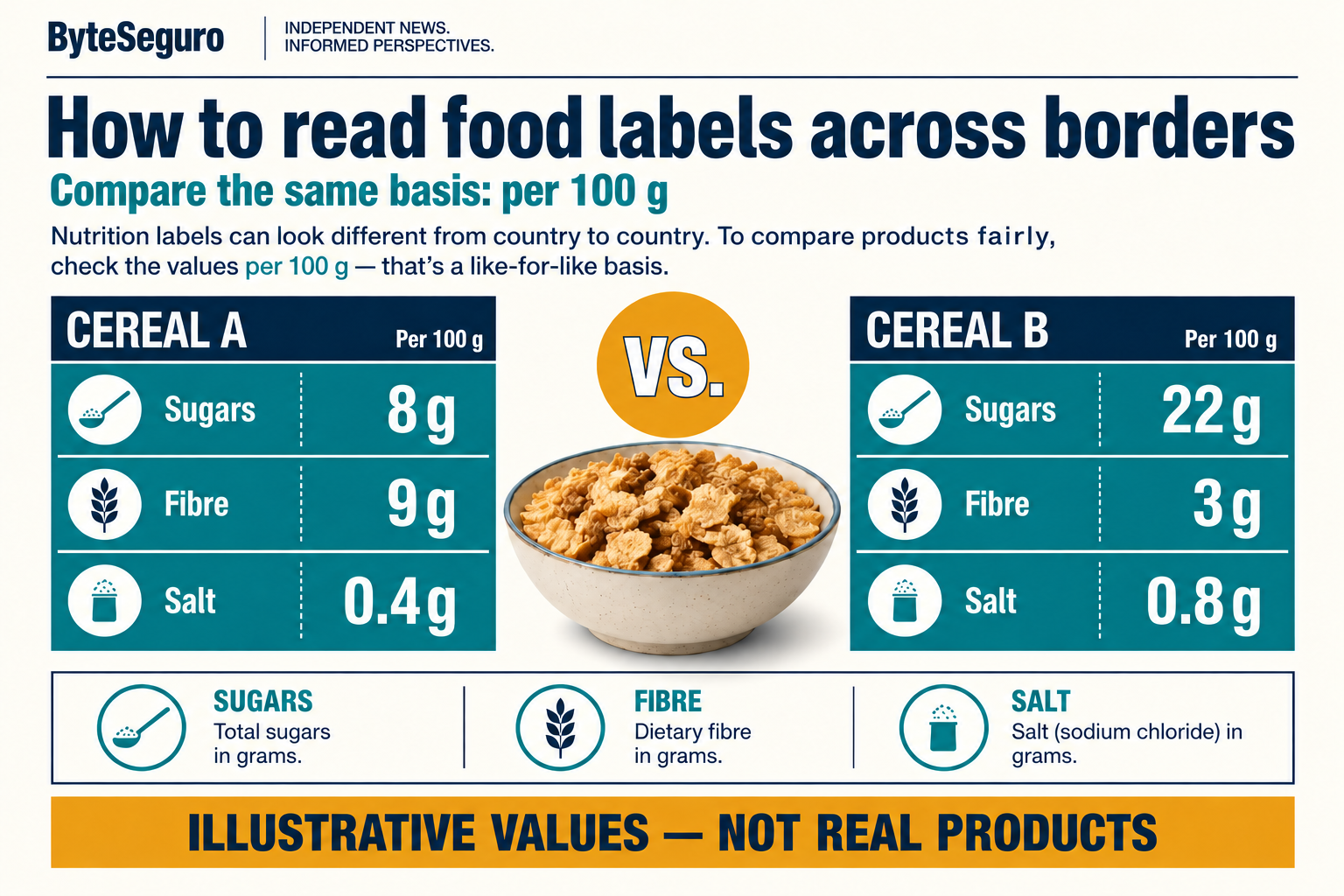
Illustrative numbers, not data about real products.
Our two sample cereals illustrate the principle, not the nutritional quality of any brand. Suppose Cereal A contains 8 g of sugars and 9 g of fibre per 100 g, while Cereal B contains 22 g of sugars and 3 g of fibre. On those two measures, A has less sugar and more fibre. That does not prove it is the better choice for everyone: compare ingredients, other nutrients, allergies, portion sizes and your own needs before drawing a broader conclusion.
A small word can change the meaning
Sugars and added sugars are not interchangeable. Total sugars can include sugars naturally present in milk or fruit as well as those added during manufacturing. US labels separate added sugars; labels elsewhere may present the information differently. The World Health Organization also uses the term free sugars, which includes sugars in honey, syrups and fruit juices. These categories overlap, but they are not identical. FDA added sugars WHO
The same caution applies to sodium and salt. Some nutrition panels report sodium, while others prominently report salt. For a rough conversion, salt in grams is about 2.5 times sodium in grams, provided both amounts refer to the same quantity of food. That does not mean every national front-of-pack symbol follows the same thresholds.
What the ingredients reveal, and what they do not
An ingredient list is not a secret recipe. In many regulated markets, ingredients appear in descending order by weight as used in manufacturing. That can tell you whether the food is mostly oats, flour, sugar or something else. It cannot tell you precisely how much of each ingredient is present unless the label also gives a percentage or quantity.
Claims such as high fibre, reduced fat or natural should be read under the rules of the country where the product is sold. A legal claim about one property is not an overall certification of healthfulness. A product could be lower in fat than a comparison product while still containing substantial sugars or salt. NHS Australia healthdirect
For someone with a food allergy, the ingredient and allergen information is not merely a nutrition preference. Declaration rules and the way allergens are emphasised vary across markets. Read the locally applicable allergen statement and follow professional advice for your particular allergy; a nutrition infographic cannot establish that a food is safe for you. FSANZ allergens
The question the label cannot answer
A food label describes a packaged product under specified measurement and labelling rules. It cannot tell you how often you will eat it, what the rest of your diet contains, whether its serving size matches your appetite, or how your circumstances change what matters most.
This is why a label comparison is most useful between similar foods, on a common measurement basis. It is less useful as a contest between unrelated items. Comparing two breakfast cereals can inform a purchase; comparing cereal with fresh fruit solely by a single number usually cannot.
Nor are the brightest colours on the front a universal language. The UK uses voluntary traffic-light formats, while other places use different front-of-pack schemes. The World Health Organization describes multiple approaches to nutrition labelling rather than a single global scoring system. NHS WHO policy
A better question at the supermarket shelf
Instead of asking whether a package is simply healthy or unhealthy, ask whether the label gives you enough comparable information to make this particular choice.
If you are choosing between similar cereals, look at the same quantity, the nutrients relevant to you and the ingredient lists. If a bold claim seems reassuring, find where the details support it. If you have an allergy or a condition that requires specialised dietary advice, do not rely on general label shortcuts.
A good food label is not a complete picture of health. It is a useful piece of evidence. Read what it actually measures, notice what it leaves out, and the decision becomes yours rather than the package's.