
world-society-planet · ByteSeguro Global
Why Does the Same Money Buy So Much Less in Some Countries?
The exchange rate tells you what your currency is worth on the market. It cannot tell you what life will cost.


Imagine two people earning what looks like the same monthly income after converting their pay into a common currency. One can comfortably cover rent, transport and groceries. The other struggles with the same essentials. Does that mean one has a better job, a stronger currency or simply cheaper living costs?
The answer is not contained in the number on a currency converter. It depends on what the money can buy, where it is spent and whose circumstances you are comparing.
One number, two very different questions
A market exchange rate answers a practical question: how much of one currency can be exchanged for another? It matters when you transfer money, pay a foreign supplier or travel abroad. The rate can move quickly with financial conditions.
A purchasing power comparison asks a different question: how much would a comparable collection of goods and services cost in each place? That is why economists use purchasing power parities, or PPPs, when comparing the size of economies and many measures of living standards. The World Bank's International Comparison Program gathers comparable prices across economies for this purpose.
The two methods are not rivals. They describe different aspects of money. Converting a salary at the market rate helps show its value for an international transfer; adjusting for local prices helps compare the volume of goods and services that money might represent.
What an identical budget can hide
Consider two fictional places, Harbour and Hilltown. They use the same imaginary currency, and the following figures are illustrative amounts, not surveyed prices or a comparison of real countries.
Suppose the monthly budget is 1,000 units in each place. In Harbour, a typical example allocation is 520 for housing, 220 for food, 120 for transport and 140 left over. In Hilltown, the same categories take 300, 180 and 80 units, leaving 440.
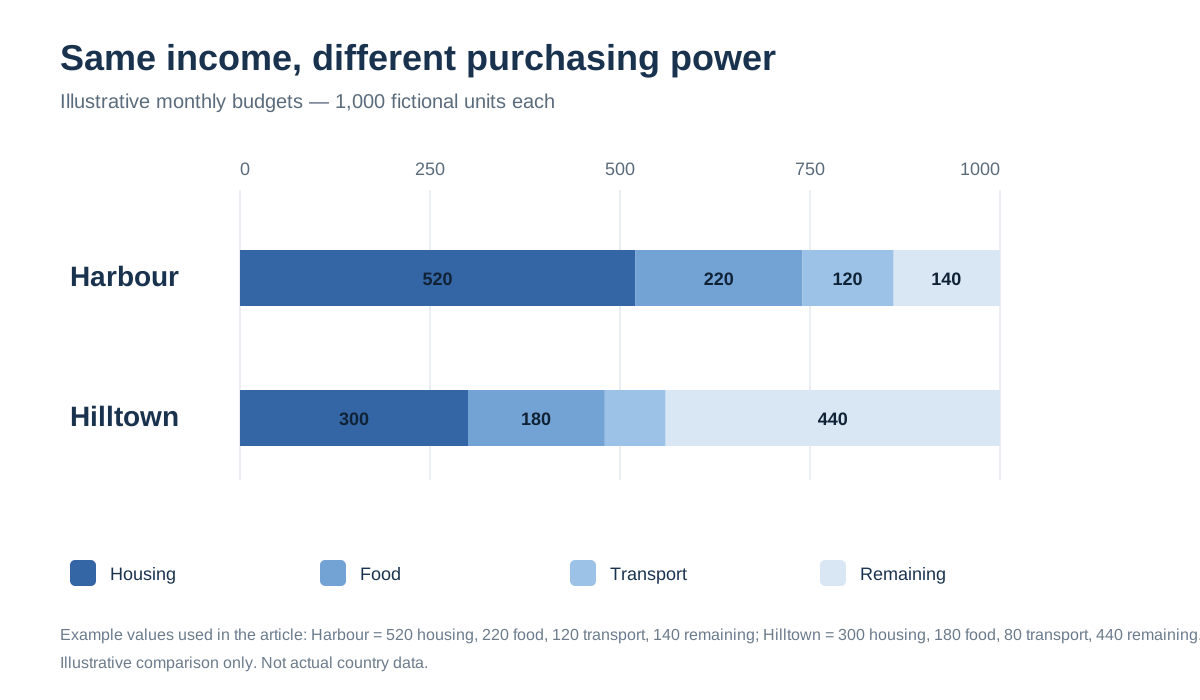
The headline income matches. The remaining money does not. A different housing market alone can change the entire picture. Even this fictional calculation is incomplete: it says nothing about the size or quality of the home, healthcare, childcare, taxes, safety, public services or how people actually live.
Equal converted income is not equal financial breathing room. Nor does a national average describe every household within a country.
Why a cheaper meal does not mean a cheaper life
Some prices move across borders more easily than others. A widely traded electronic device may be priced within a relatively narrow global range, once taxes and distribution costs are considered. Rent, a haircut, local transport or childcare depend much more heavily on local wages, land, regulations and services.
That difference helps explain why international price levels do not move in lockstep with exchange rates. It also explains why a one-product comparison, however memorable, cannot stand in for an entire household budget. The IMF notes that meaningful PPP comparisons require a broad collection of goods and services, not a single purchase.
The details matter. Two supermarket baskets may contain different foods. A household may rely on public transport in one city and need a car in another. Public education or healthcare may be financed differently. Local climate can change energy costs. Each of these choices affects what it means to live comfortably.
The cost of living is not the same as affordability
A place can have low average prices and still be difficult to live in if local pay is lower. Affordability is a relationship between resources and costs, not a property of prices alone.
For that reason, it is useful to keep three questions separate:
How expensive is the place? This concerns the prices of comparable goods and services.
How much can a particular household spend? This depends on earnings, taxes, transfers, debt, dependants and other circumstances.
What quality of life does that spending support? This reaches beyond prices to access, housing conditions, working time, services and personal needs.
The OECD publishes comparative price-level indices derived from PPPs and market exchange rates. These are useful for broad cross-country comparisons, but they should not be mistaken for a ready-made budget for a particular visitor or resident.
Three comparisons that should not be mixed up
Across countries, at the same time. PPP-adjusted figures help compare economic output or consumption while accounting for differences in price levels. They do not guarantee that your preferred basket costs the same everywhere.
Across years, in the same country. Inflation changes what local money buys over time. A salary increase can be smaller than the rise in prices, leaving purchasing power lower. This is a question of real, rather than merely nominal, income.
Across countries and years. The comparison needs both kinds of adjustment. International dollars are statistical units used to express purchasing power on a comparable basis, not banknotes that travellers can spend. Our World in Data explains how PPP and inflation adjustments work together.
These distinctions help avoid a common mistake: treating a currency conversion, a cost-of-living index and a measure of household welfare as though they were interchangeable.
If you are deciding whether to move
The right comparison is personal rather than a global ranking. Start with the pay you would actually receive after applicable deductions, then list the costs that are hard to avoid: suitable housing, essential travel, food, healthcare, childcare where relevant and any obligations that continue in another currency.
Check what is included in published figures and the year to which they refer. National averages can conceal large differences between cities, neighbourhoods and household types. Use current local listings and official information for decisions involving a specific move; PPP estimates are not live retail price quotations.
Finally, consider what cannot be fitted into a single price index: personal support, language, accessibility, security, time and the services you can actually use. A place may look inexpensive statistically while being an unsuitable or unaffordable choice for you.
The comparison worth making
An exchange rate can convert a sum of money. It cannot convert a way of life. The same nominal amount can buy different combinations of housing, food, transport and services, and the effect on a person's wellbeing depends just as much on income and circumstances as on national prices.
For international comparisons, use the appropriate economic measure. For an individual decision, examine the costs and resources that genuinely apply. The useful question is not simply, “How much is that in my currency?” It is, “What would that money allow me to do there?”