
world-society-planet · ByteSeguro Global
Why Is Internet Access Still Unequal Across the World?
A signal can reach a community without giving everyone a meaningful connection. The gap is bigger than the map suggests.
A network can reach a village. A phone can show several bars of signal. A government can report that almost everyone lives within reach of mobile broadband. Yet someone in that same village may still have to choose between buying data and paying for another essential expense.
That is one of the central contradictions of the connected world: having coverage does not mean having access that a person can afford, use and rely on.
The International Telecommunication Union (ITU) estimated that six billion people used the internet in 2025. Another 2.2 billion remained offline. The gap is not spread evenly across the planet. Income, geography, devices and digital skills all influence who can use the opportunities that connectivity promises. ITU, Facts and Figures 2025
One planet, radically different opportunities
In the ITU's 2025 estimates, 94% of people in high-income economies used the internet, compared with 23% in low-income economies. The global estimate was 74%. Those figures describe use, not the proportion living under a network signal. ITU, Global Connectivity Report 2025
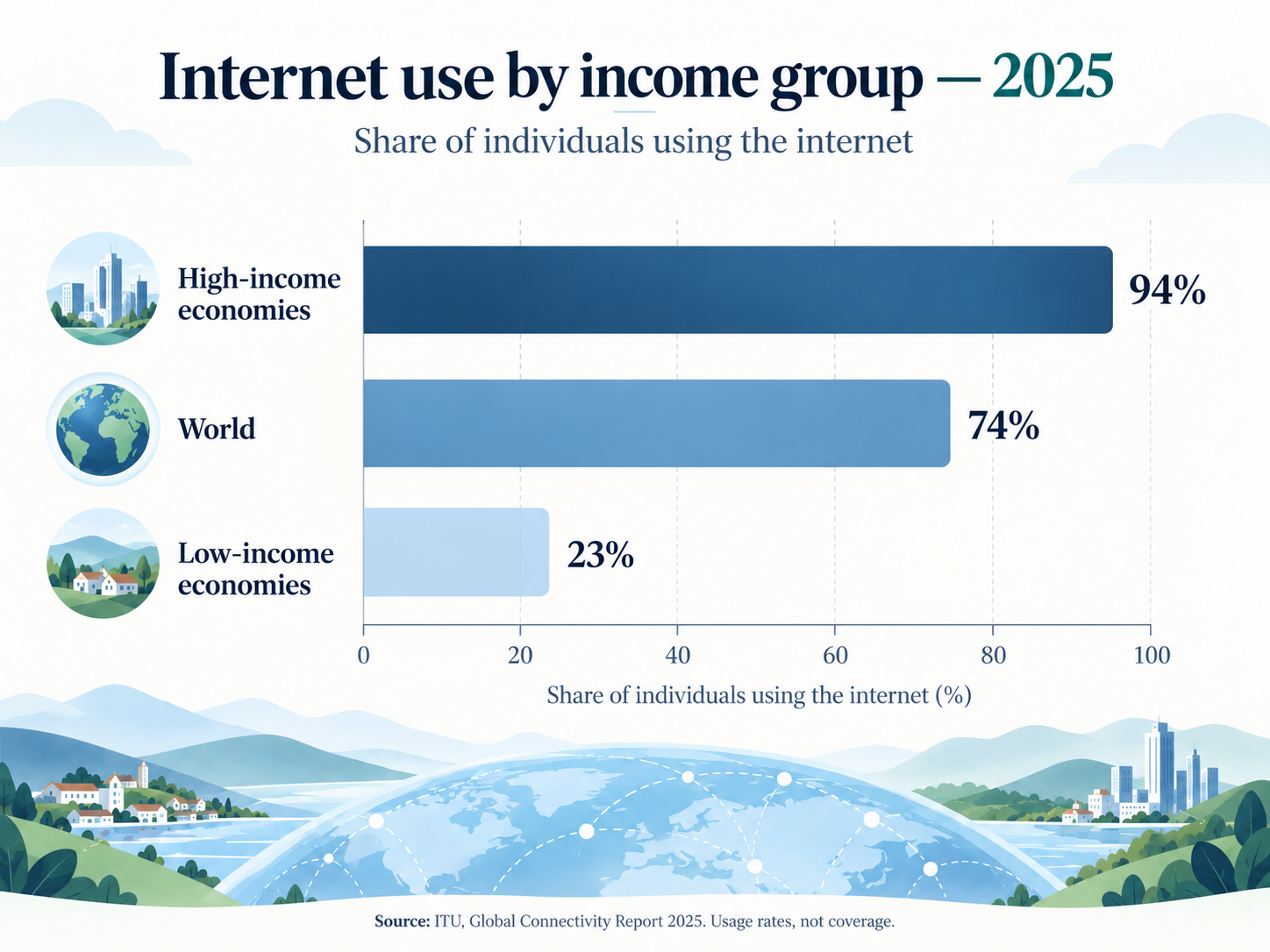
That contrast is striking, but it is not a complete explanation. A network may exist in a district while households remain unconnected. A home might have a connection but lack a suitable computer. A student may be able to receive messages but not comfortably attend a video class. Simply declaring a community 'connected' hides these differences.
The distance between coverage and participation
Imagine two neighbours living under the same mobile network. One has a reliable device, an affordable data plan and a quiet place to study. The other shares a phone, can only buy small amounts of data and has to leave home to find a stronger signal. The connection icon may look similar. Their ability to use the internet is not.
This is an illustrative situation, not a reported interview or description of a particular country. It makes a critical distinction visible: infrastructure is one condition for access, but not the whole experience.
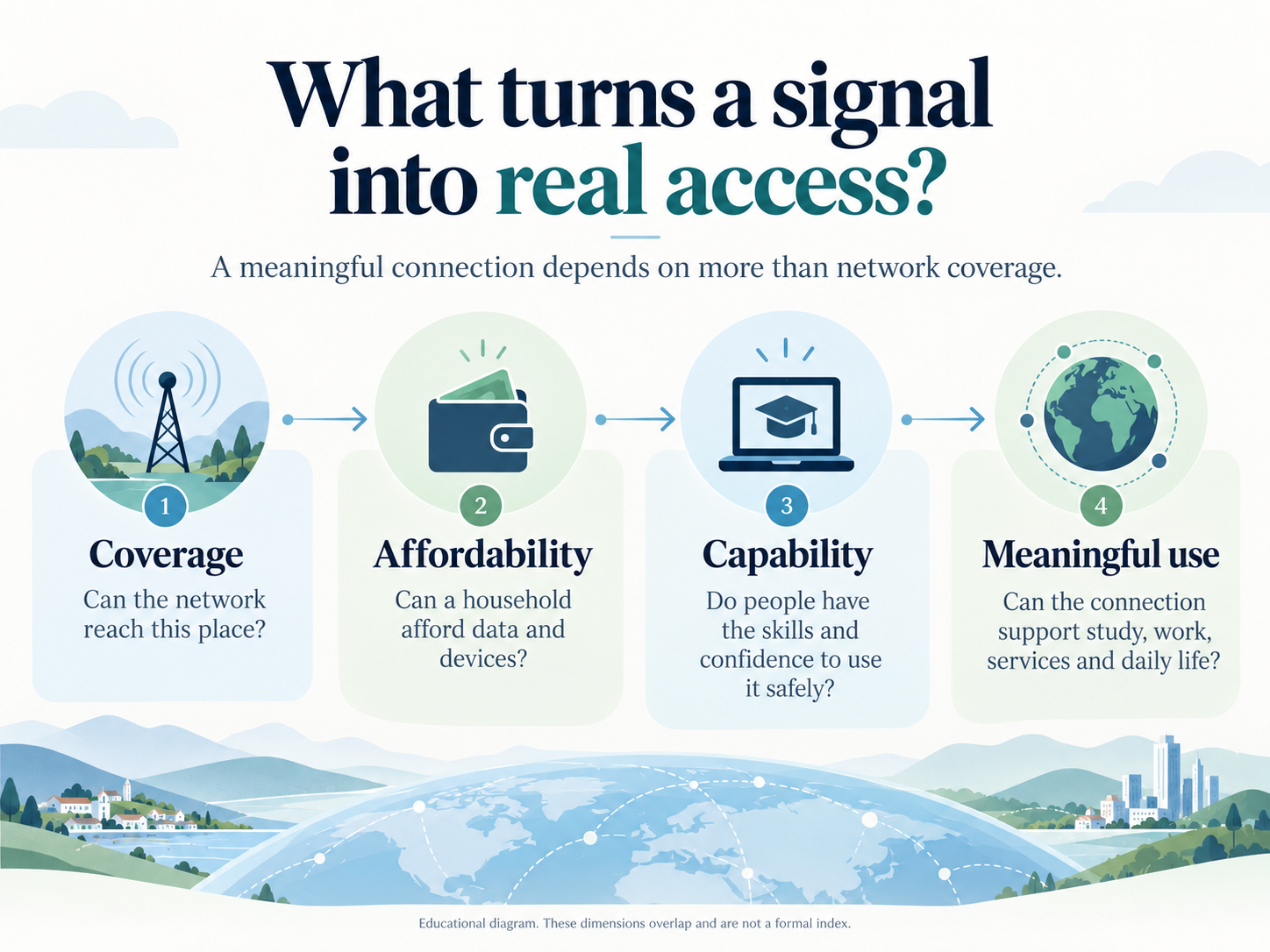
Coverage answers whether service reaches a location. Affordability asks whether regular access and suitable equipment fit a household's resources. Capability includes the skills, language and confidence needed to use services safely. Meaningful use asks whether that access actually works for education, employment, public services and communication.
These stages are connected, not a universal sequence or a new statistical index. Someone can face several barriers at once.
A device can be the missing infrastructure
A mobile phone is an extraordinary tool, but not every task works equally well on a small screen. Filling in a complicated application, preparing a lengthy document or studying from multiple sources may be harder without access to a computer, reliable power and sufficient data.
The World Bank's 2026 analysis identifies the cost of smartphones, computers and data plans as major barriers. It also highlights digital skills: being able to get online does not automatically mean being able to evaluate information or use online services confidently. World Bank, The Global Internet Gap
That matters when a service moves entirely online. Digital delivery can make an application easier for some people while creating a new obstacle for others.
The classroom shows what the headline numbers miss
Consider internet access at home, rather than internet use anywhere. These are different measures and must not be mixed. In a joint UNICEF–ITU study published in 2020, about two-thirds of children and young people aged 25 or younger were estimated to lack internet access at home. That is a historical finding, not an estimate of their situation in 2026. UNICEF–ITU, How Many Children and Young People Have Internet Access at Home?
The lasting lesson is not the old percentage. It is that a school, a public hotspot and a household connection solve different problems. A student who can use the internet briefly at school does not necessarily have the same opportunity to research, practise or complete assignments at home.
A more recent UNICEF report, Childhood in a Digital World (2025), likewise emphasises that wealth and geography shape children's connectivity and that digital skills matter alongside access. UNICEF Innocenti
Why a single percentage can mislead
International reports use different definitions and reference periods. The ITU's estimate of internet users concerns people who have used the internet within a defined recent period. Household connectivity reports ask whether a connection is available at home. Network-coverage statistics concern the reach of technology, not its price or reliability.
None of these figures is necessarily wrong. They answer different questions. Problems arise when they are presented as though they measure the same thing.
A country can report impressive mobile broadband coverage and still have significant gaps in actual use. Likewise, growth in the number of people online does not, on its own, establish whether connections became affordable, dependable or accessible to people with disabilities.
What a meaningful connection would change
For the person searching for employment, the important question may be whether online applications work on a basic phone. For a student, it may be whether lessons can be accessed without exhausting a data allowance. For an older adult, it may be whether a public service is understandable and safe to use. For someone with a disability, accessibility features may determine whether the service is usable at all.
The Internet Society has argued that the digital divide includes not just availability and affordability but relevant services, suitable technology and digital literacy. Language and local usefulness are therefore part of the story, not decorative details. Internet Society, What Is the Digital Divide?
That perspective changes how progress should be judged. More towers matter. So do lower recurring costs, suitable devices, accessible design, digital education and services that remain available through other channels when necessary.
The unfinished promise
The world has achieved an enormous expansion of connectivity. The fact that about three-quarters of humanity used the internet in 2025 is evidence of that progress. It should not obscure the lives behind the remaining quarter or the inequalities among people counted as connected.
The most useful question is no longer simply 'Does the internet reach this place?' It is 'Can people use it well enough to do what they need to do?'
A signal can cross a mountain or a border. Opportunity still depends on what happens after it arrives.
Sources and methodology
This article draws on ITU global estimates for 2025, World Bank analysis published in 2026, UNICEF research and the Internet Society's explanation of meaningful connectivity. The 2020 UNICEF–ITU household study is clearly dated and is not used as a current population estimate. The two-neighbour example is illustrative, not a field report. Percentages describing internet use, network coverage and access at home are deliberately kept separate.